Barn Red Flags: What to Watch for Before You Sign Up
Directory note. HiveEquine is a directory. Listings are options to evaluate, not endorsements. We do not rank, rate, or inspect barns. Verify certifications, ratios, pricing, and protocols directly with the barn before you commit.
Three things to watch for on your first barn visit. None of them are the indoor.
The most-upvoted thread in r/Equestrian on barn shopping is titled "My boarding story from hell." The second is "Opinions needed, boarding options and red flags?" The community has already written this guide. This version organizes it and pairs the warning signs with what to ask, what to look for, and what to walk away from.
This is for two readers: the parent looking for a kid's lesson barn, and the adult or owner looking for boarding. The red flags overlap more than they diverge.
The honest answer up front
A barn is showing you red flags if any of the following are true on your tour:
- The schoolies or boarders are visibly underweight, have rain rot, or have hooves that haven't been trimmed in eight or more weeks.
- The trainer answers your cost question with "if you have to ask the price, you can't afford it."
- There's no helmet check before lessons, or the helmets in the loaner bin are sun-faded and dust-covered.
- The trainer can't tell you whether they are a USEF member or whether they have completed US Center for SafeSport training.
- The barn refuses to let you watch a lesson before you sign up.
- The boarder agreement is verbal, with no written terms.
- The owner badmouths former clients or boarders to you on the tour.
Any one of those is a serious flag. Two is a no.
The rest of this guide explains what each flag means, why it predicts trouble, and how to ask the question without sounding like you're running a deposition.
Why barn evaluation is a real problem
Barn shopping is hard because the customer rarely has the expertise to evaluate the product. A new lesson parent doesn't know what a healthy schoolie looks like. A new boarder doesn't know what good turnout management looks like. The barn knows this, and the bad ones lean on it.
The community's warning signs hold up because they're pattern-recognition from people who learned the hard way. "My boarding story from hell" exists because someone trusted a verbal agreement, signed a horse in, and then watched the barn flip the rules every month.
Read the red flags before the tour, not after.
Step-by-step: how to handle a barn visit
Before you go
- Search the barn name plus "review" and the barn name plus the trainer's name. Reddit, Facebook horse-community groups, COTH (Chronicle of the Horse) forums. A barn with public complaints in any of those places is worth a second look.
- Check the trainer's USEF membership status if the barn is English-discipline-presenting. usef.org has a public lookup. Not every good trainer is a USEF member, but most active hunter/jumper, dressage, and eventing pros are.
- Look up the trainer in the US Center for SafeSport Centralized Disciplinary Database. Anyone teaching minors should not appear in it. (uscenterforsafesport.org)
- Call to schedule the tour. A barn that won't host a tour by appointment isn't the right barn.
On the tour
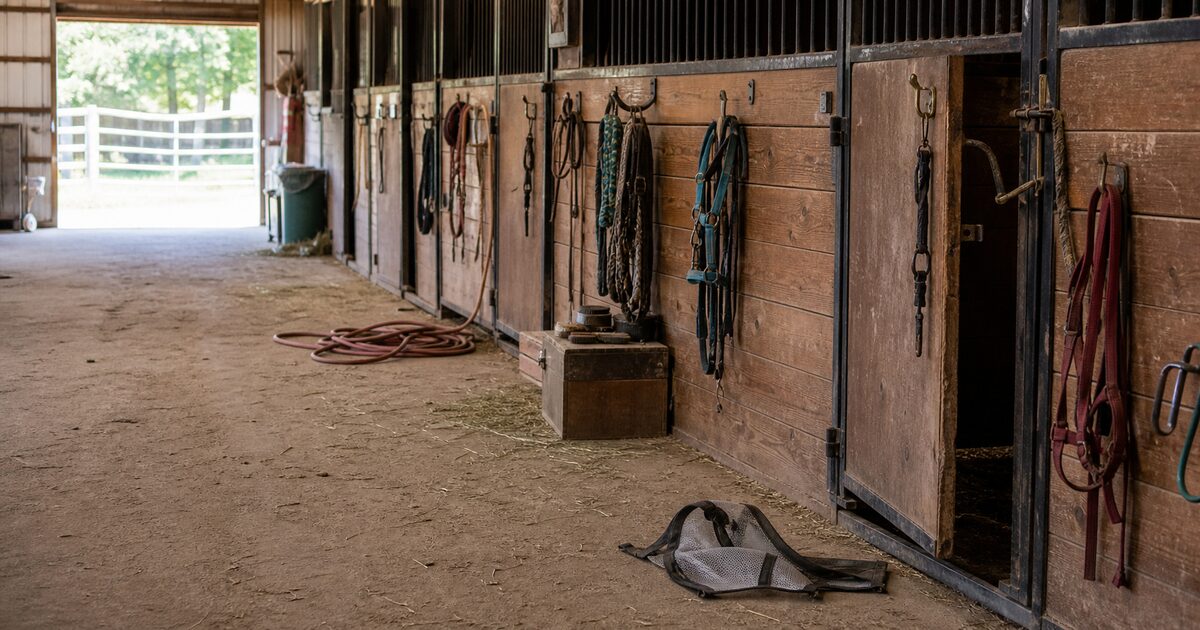
Walk through the whole barn, not just the lobby and the indoor. You're looking for three roles working in sync: owner, farrier (or evidence of recent farrier work), and vet (or evidence of vet protocols). A barn where the owner manages without a real farrier and vet relationship is a barn that will fail one of those tests on your horse's worst week.
Specifically, look at:
- The schoolies and boarders. Bright eyes, decent weight (you should see no ribs but feel them with light pressure), no rain rot, no patchy coat, hooves trimmed within the last six weeks. If the barn has horses with cracked hooves and visible thrush, the farrier-vet-owner triangle isn't running.
- The cross-ties and grooming area. Tack on the racks. Hoof picks and brushes within reach. A wash rack that's been used recently. Cross-ties at the right height with rubber matting underneath.
- The aisle. Swept. Hay and shavings stored away from the main aisle. No exposed wiring. Working fire extinguishers visible.
- The stalls. Bedding clean, water buckets full and not algae-coated, hay in nets or on the ground depending on barn protocol. Stalls bedded deep enough to see the bedding when you walk in, not just enough to cover the mats.
- The turnout fields. Grass or dirt as expected, no visible barbed wire, fencing intact, run-in shelters present and clean. Note the herd dynamics: calm groups grazing, not constant chasing.
- The tack room. Saddles on racks, bridles hung, tack clean and conditioned. Boarders' tack lockable.
What to ask the trainer
Ten questions, in order of how easy they are to ask:
- What disciplines do you teach, English, Western, or both? If both, what schoolies are dedicated to which?
- What's the price for a group lesson and a private lesson, in the format I'm asking about?
- How long have your school horses been with you?
- How often does the farrier come, and who is it?
- Who is your vet? What's the vaccination and coggins protocol for school horses and boarders?
- What is your policy on helmet certification and helmet checks?
- Are you a USEF member? Have you completed US Center for SafeSport training?
- May I watch a lesson before I commit?
- Do you have a written lesson policy or boarding contract I can read?
- Why did your last lesson client or boarder leave?
The honest answers to these questions are short and specific. The dishonest answers are vague, redirecting, or hostile.
Red flags and green flags
Red flags
Horse welfare
- Visible weight loss on multiple horses, especially schoolies who work daily.
- Chronic rain rot, lice marks, or untreated wounds.
- Hooves visibly overgrown or cracked.
- A "sour" schoolie who pins ears, tail-swishes, or grinds teeth in cross-ties. That's a horse telling you it's being overworked or its tack doesn't fit.
- No vet on file, or "we just call whoever is available."
Operations
- Verbal-only lesson or boarding agreements.
- Refusal to let you watch a lesson or tour the full property.
- Lesson rates that change with no published schedule.
- The barn is "always understaffed" and lessons run short or get cancelled day-of.
- No written safety protocols (helmet, fall, evacuation).
People
- The trainer badmouths former clients on the tour.
- The trainer can't or won't state their credentials.
- The trainer's response to the price question is "if you have to ask, you can't afford it."
- Verbal hostility toward a boarder or client during your visit.
- Working students with no written agreement, working hours that drift, or who are riding client horses unsupervised.
SafeSport / USEF specific (any barn that teaches minors)
- Trainer isn't a USEF member but presents as a hunter/jumper or dressage barn.
- Trainer hasn't completed Center for SafeSport training.
- Adult-rider/minor-rider boundaries are loose (e.g., overnight stays at the barn unsupervised, social-media DMs).
- Trainer's name appears in the Center for SafeSport Centralized Disciplinary Database.
Green flags
- The trainer answers the price question with a number and a format.
- Schoolies are healthy, named, and have been at the barn for years.
- The vet and farrier are named on the website or on a posted schedule.
- The lesson contract or boarding agreement is in writing, with clear cancellation and weather policies.
- The trainer mentions other adult or kid riders in your skill range when you ask.
- The barn has a covered or indoor arena, or a clear fair-weather policy with credits for cancellations.
- USEF membership is current; SafeSport training is current; certifications are posted.
- The trainer says no to riders or horses who aren't a fit. A barn that takes everyone is a barn that has no standard.
NJ-specific notes
A few things specific to riding and boarding in New Jersey:
- Coggins. New Jersey requires a current negative Coggins test for any horse changing barns or attending a show. Boarding contracts should reference the Coggins requirement; lesson barns should have current Coggins on every school horse. Ask to see one.
- EHV protocols. Equine Herpesvirus outbreaks have shut down NJ barns periodically. A well-run barn has a written quarantine and biosecurity protocol: new horses are quarantined for 14-21 days before joining the herd, temperature-checked daily.
- Rutgers Equine Science Center publishes NJ-specific guidance on hay quality, pasture management, and disease protocols (esc.rutgers.edu). Barns that reference Rutgers research are barns that are paying attention.
- NJ Department of Agriculture maintains current equine disease alerts at nj.gov/agriculture. A barn that knows what's currently circulating in the state is a barn that's reading.
What to do this week
If you're touring barns now:
- List three barns within a 30-minute drive. Read every public review and forum thread on each.
- Schedule tours at all three. Visit during a lesson if the barn allows, not in dead time.
- Use the ten-question list. Take notes after each tour, not during.
- Ask each barn for a written contract before you commit.
- If two of the three are full or have a waitlist, that's normal. Well-run barns fill up. Get on the waitlist.
- Walk away from any barn that hits two or more red flags from the list above. There's always another barn.
For specific barn lists by area, see horseback riding lessons in Monmouth County, NJ and horseback riding lessons in Hunterdon County, NJ. For the broader cost context, see the horseback riding lessons cost guide. For boarding-specific evaluation, see signs of a well-run boarding barn.
Frequently asked questions
What is the single biggest red flag at a riding barn? A trainer who refuses to quote a price. "If you have to ask the price, you can't afford it" is the most-quoted line in barn shopping and the most consistently wrong. A trainer who won't quote a lesson price won't be straight with you on anything else either.
How can I tell if the school horses are well cared for? Bright eyes, decent weight (no visible ribs but you can feel them with light pressure), no rain rot, no patchy coat, hooves trimmed within the last six weeks. School horses that have been at the barn for years are a strong positive signal.
Is it a red flag if the barn won't let me watch a lesson? Yes. A barn that won't let a prospective client watch a lesson is hiding something, usually how the lesson actually runs versus how the trainer describes it.
What should be in a written boarding contract? Monthly fee, what's included (hay, grain, bedding, turnout schedule), what's extra (blanketing, holding for vet/farrier, supplements), late-fee terms, notice period to leave, vet/farrier contacts, vaccination and coggins requirements, and a clear escalation if the boarder or barn breaks the agreement.
Should I check SafeSport on a barn that only teaches kids? Yes, especially. Anyone teaching minors should be SafeSport-trained, and any USEF-registered trainer must be. Check the Centralized Disciplinary Database before you sign your child up.
The trainer at the barn I want isn't a USEF member. Should I be worried? Not always. Many excellent Western barns and recreational lesson barns operate outside USEF. The question is whether the trainer can articulate their credentials at all. A trainer who shrugs at the question is a different problem than a trainer who is intentionally outside USEF for sound reasons.
My horse is at a barn now and I'm seeing some of these red flags. What do I do? Document what you're seeing. Identify two or three alternative barns. Give 30 days' written notice per most contracts. If the barn responds with hostility or attempts to hold the horse, contact NJ Department of Agriculture and a local equine attorney. The math doesn't math on staying somewhere bad.
Is barn drama really a red flag, or just normal? Some barn drama is normal: humans, horses, money. The red-flag version is ongoing, public, and aimed at clients. A barn where the owner badmouths former clients on a first tour is a barn where you'll be the next former client.
Find a barn that fits in the HiveEquine directory. Filter by county, discipline, and audience.
Disclaimer
This article is informational only and reflects best-effort research at time of publication. Information may change. We're a directory — we surface options and how to evaluate fit; we don't replace direct conversations with the providers, programs, or professionals listed. Editorially reviewed by HiveEquine Editorial. Not legally reviewed. Last reviewed: 2026-04-25.
Safety advisory — last reviewed 2026-04-25. This page is informational and is not legal, safety, or compliance advice. Riding-helmet laws, instructor-credential standards, and liability waivers vary by state and barn. Listings and red-flag patterns reflect publicly reported incidents and community knowledge at publication; inclusion is not endorsement, absence is not criticism. For any safety concern, contact the barn directly and, where conduct may be unlawful, report to local law enforcement and the appropriate governing body (PATH Intl., USEF, USHJA). Reviewed editorially by HiveEquine Editorial — not legally reviewed.